Design-Build vs. Architect + General Contractor: Which Is Right for Your Custom Home?
Minima’s recommendation: start with formal design-build if you want one owner contract and a built-in structure for designer–builder coordination. Choose separate architect and contractor agreements if a direct owner–architect relationship and separate builder selection matter more. If you want both, keep the contracts separate and bring a contractor into design early. Compare the agreements, scopes, people, pricing checkpoints, and change process—not the label.

Minima’s recommendation: choose the responsibility map before you choose the label. Start with formal design-build if you want one owner contract with an entity responsible for design and construction, plus a built-in structure for designer–builder coordination. Choose separate architect and contractor agreements if a direct owner–architect relationship and separate builder selection matter more. If you want both, keep the contracts separate and bring a contractor into design early.
None of those routes is automatically cheaper, faster, better designed, or lower risk. The useful comparison is the actual agreements, scopes, people, pricing checkpoints, and change process—not the words on a firm’s website.
Our recommendation: choose the responsibility map first
Formal design-build puts design and construction under one owner–design-builder agreement. The design-builder may employ or retain the architect and construction parties, so “one contract” does not necessarily mean every discipline is employed by the same company.
The conventional architect-plus-contractor route gives the owner separate agreements: one with the architect and one with the contractor. The architect may also help with bidding and construction administration when those services are included in the owner–architect agreement.
The third path is a practical hybrid. The owner keeps separate architect and contractor agreements but brings the contractor into design for preconstruction input. That can put construction questions on the table before the documents are finished without combining contractual responsibility.
The American Institute of Architects’ contract diagrams and the Design-Build Institute of America’s owner guidance support these structural distinctions. They do not establish a universal performance winner.
Compare the three delivery paths
Formal design-build
Contract map: one owner–design-builder agreement for design and construction.
Design relationship: the designer works within or under the design-builder’s team.
Builder selection: the owner selects the combined team early.
Construction input: intended to be present during design; verify who participates and at which milestones.
Owner diligence: confirm the named design professionals, licensed contractor, scopes, insurance, decision rights, estimating method, and responsibility for changes.
Often fits when: one contractual point of responsibility and an integrated coordination structure matter more than selecting the builder separately.
Separate architect + contractor
Contract map: separate owner–architect and owner–contractor agreements.
Design relationship: the architect contracts directly with the owner.
Builder selection: the owner may select the builder after the design advances.
Construction input: may arrive later unless early preconstruction is added.
Owner diligence: connect the two scopes explicitly, including bidding, construction administration, field questions, submittals, and responsibility for design changes.
Often fits when: a direct owner–architect relationship or the option to compare builders against a developed common scope matters most.
Early-contractor hybrid
Contract map: separate agreements remain in place while a contractor provides preconstruction input during design.
Design relationship: the architect still reports directly to the owner under the owner–architect agreement.
Builder selection: the contractor may be selected early, or the agreement may preserve a later construction decision.
Construction input: begins during design, subject to the preconstruction scope.
Owner diligence: define the fee, deliverables, estimate assumptions, access to trade input, ownership of work product, and what happens if that contractor does not build.
Often fits when: the owner wants a direct architect relationship and early construction input without a single design-build agreement.
This is a comparison of structures, not outcomes. A clear team can make any of the three work. A vague scope can undermine any of them.
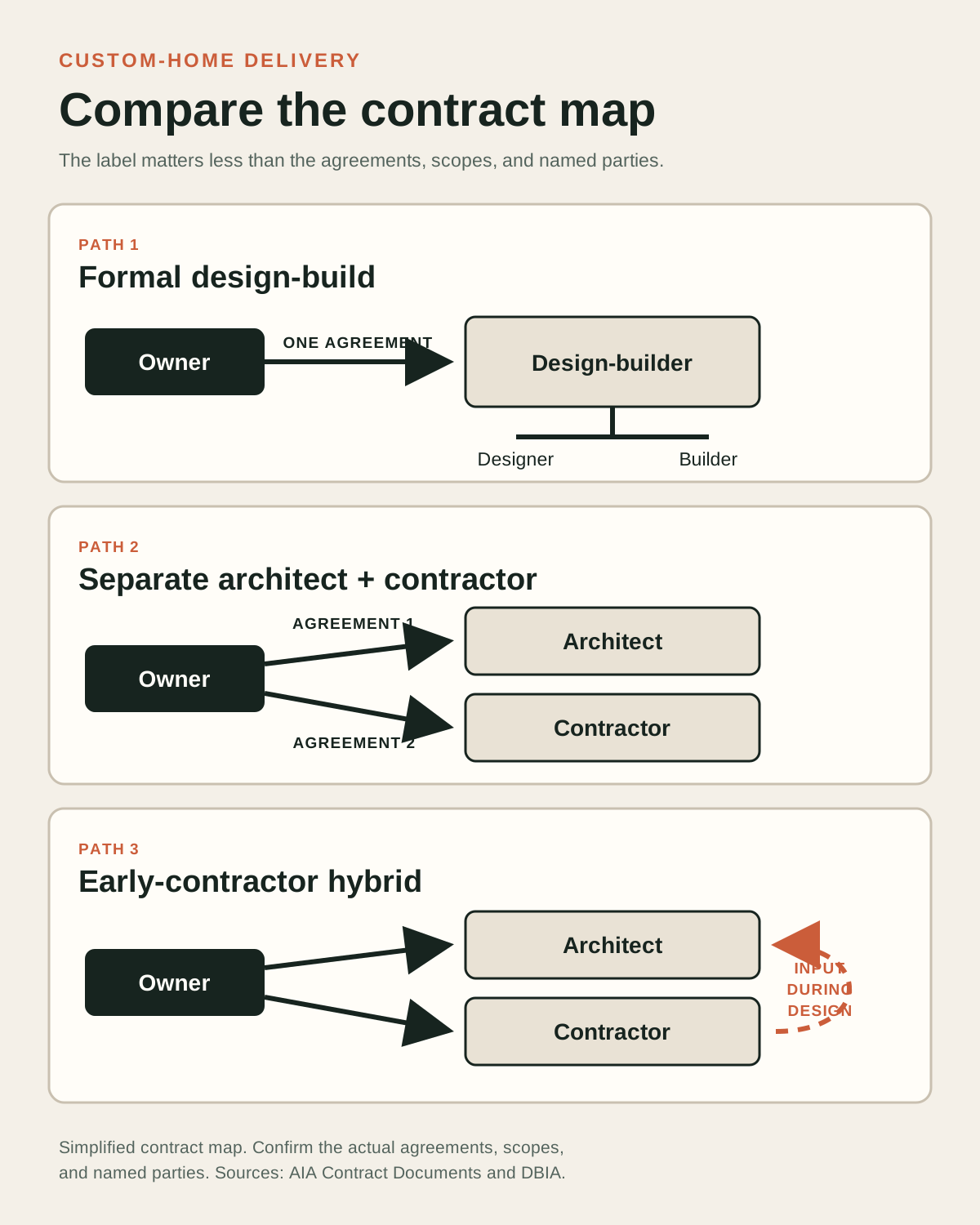
Simplified contract map. Arrows from Owner show the primary agreements; the branch under Design-builder shows its coordination of designer and builder; the hybrid’s dashed arrow shows contractor input during design. Confirm the actual agreements, scopes, and named parties.
At a glance: compare the two primary contract structures
| Criterion | Formal design-build | Separate architect + contractor |
|---|---|---|
| Primary agreements | One owner–design-builder agreement covers design and construction. | The owner holds separate agreements with the architect and contractor. |
| Design relationship | The designer works within or under the design-builder’s team. | The architect contracts directly with the owner. |
| Builder selection | The owner selects the combined team early. | The owner may select the builder after design advances. |
| What to verify | Named parties, included services, pricing milestones, design authority, and change process. | How the two scopes connect, including bidding, field questions, submittals, and design changes. |
Decision path: start with what you want to control
Choose formal design-build as your starting lane when your highest priority is one owner contract covering design and construction. Then test whether the proposed agreement really supplies the clarity the label promises: named parties, included services, pricing milestones, design authority, construction-phase design involvement, and a written change process.
Choose separate architect and contractor agreements as your starting lane when a direct architect relationship or the ability to select the builder separately is more important. Then decide who will manage the interfaces between the contracts and whether the architect’s scope includes bidding support and construction administration.
Choose the early-contractor hybrid when you want the separate relationships but do not want construction input deferred until the design is complete. Then make the preconstruction engagement concrete. “Collaborative” is not a scope: the agreement should say what the contractor will price, review, document, and deliver.
If you are still undecided, ask every team to draw the proposed contract map on one page. Put the legal entities, named people, decision rights, deliverables, and transition rights next to the arrows. The differences usually become easier to see.
Normalize every proposal before comparing price
An early number is only as specific as its inputs. Neither delivery method creates cost certainty before the site, scope, engineering, selections, and timing assumptions are sufficiently understood.
Design-build creates a mechanism for design and construction conversations to happen as design develops. A separate route can create a common drawing set for contractor proposals. Either advantage disappears when the estimates do not cover the same work.
Build one comparison sheet and make each team mark what is included, excluded, allowed for, or still unknown:
Architecture, structural, civil, landscape, and interior-design services.
Survey, geotechnical, drainage, and other site investigations.
Preconstruction, estimating, and pricing updates.
Permit coordination, agency responses, fees, and private design review.
Utility work, grading, pools, landscape, walls, and other site improvements.
Allowances, contingencies, escalation assumptions, and owner-supplied items.
Contractor fee, overhead, insurance, and bonds if applicable.
Construction administration, site observation, and field-question response.
The point at which the price can change and the documentation required for a change.
Do not compare a design-only fee with a design-and-construction proposal as though they describe the same route. A lower headline with broader exclusions is not necessarily a lower project cost.
Arizona diligence before you choose a team
Start with the parcel’s jurisdiction
Maricopa County handles planning and building-permit review for unincorporated areas. A parcel inside an incorporated city or town starts with that municipality. Confirm the parcel and jurisdiction before accepting a generic approval path or schedule.
Public approval and private restrictions can be separate. Depending on the property, an HOA, architectural committee, CC&Rs, or community design guidelines may apply in addition to permits.
Verify the exact contractor entity and classification
Use the Arizona Registrar of Contractors’ license search and pre-hire guidance. Check the exact legal entity in the proposed agreement—not only the brand name—and confirm that its current classification covers the contracted work.
Verify the named professionals and required submittals
The Arizona Board of Technical Registration provides registrant and business-status searches. Ask the proposed team to identify the professionals of record, then ask the permitting authority which project-specific professionals, sealed documents, engineering, and submittals are required. Do not accept a blanket claim that every Arizona custom home follows the same professional or approval path.
Separate confirmed conditions from assumptions
Depending on the parcel, early work may need to address drainage or floodplain conditions, hillside or grading requirements, access, utilities, septic, easements, or private design review. Ask: “Which conditions have been confirmed for this parcel, by whom, and which remain assumptions in the schedule and budget?”
Questions every team should answer
Which legal entity will I contract with for design, and which for construction?
Who are the named design professionals and contractor of record, and how can I verify their current credentials?
Who is responsible for architecture, engineering, interiors, permitting, and construction administration?
At which design milestones will I receive an estimate, and what information supports it?
What is excluded from the fee and construction budget?
How are allowances, contingencies, escalation, and owner changes handled?
When can I compare contractor or trade pricing, and what is the common scope?
Who advises me when design, cost, schedule, code, or constructability priorities conflict?
Who responds to permit, private-review, and field questions, and are those services included?
What happens if the design and construction teams disagree?
What rights do I have to drawings, models, estimates, and work product if I change course?
What would another qualified team need in order to continue the project?
Red flags that matter in any delivery model
“Design-build” appears in the marketing, but the proposal does not identify who is contractually responsible for design and construction.
The team cannot name the professionals and licensed contractor responsible for the work.
A budget is presented as certain before the site, scope, selections, and timing assumptions are stated.
Expected services are omitted without making the exclusion obvious.
The team resists putting pricing checkpoints, decision rights, or change procedures in writing.
Proposals are called comparable even though assumptions, allowances, and exclusions have not been normalized.
The schedule does not identify approvals, long-lead decisions, dependencies, or owner responsibilities.
The portfolio is compelling, but the team cannot explain who actually performed each role.
Bring this checklist to every team interview
- Identify the exact legal entities responsible for design and construction.
- Name the design professionals and contractor of record, then verify current credentials.
- Mark every included, excluded, allowed-for, and still-unknown cost item.
- Define pricing checkpoints, estimate assumptions, and the written change process.
- Assign responsibility for permits, private review, field questions, and construction administration.
- Confirm rights to drawings, models, estimates, and work product if the project changes course.
A practical conclusion
Before interviewing firms, write a one-page brief: the parcel or site shortlist, the spaces you need, the two or three design qualities you will not compromise, a target budget and what it must include, the desired move-in window, and how much direct design involvement you want.
Give the same brief to each team. Ask for its contract map, scope, people, milestones, estimate assumptions, and change process in a comparable format. Then choose the structure that matches how you want advice, decisions, and responsibility to work.
If one owner contract and a built-in designer–builder coordination structure are the priority, start with formal design-build. If a direct owner–architect relationship and separate builder selection matter more, start with separate contracts. If you want the latter with construction input during design, define an early-contractor hybrid.
The label is the beginning of diligence, not the end. See how Minima describes its approach, then verify the actual proposal and agreements for your project.
Sources and scope
The delivery-method definitions and diagram follow the AIA Contract Documents contract-relationship diagrams and the Design-Build Institute of America Owners FAQ.
Arizona diligence references the Arizona Registrar of Contractors Before You Hire guidance, the Arizona Board of Technical Registration, Maricopa County Permitting Services, and Maricopa County Construction Permit Information.
This guide compares project-delivery structures and owner diligence. It is not legal, architectural, engineering, or contracting advice. Project requirements depend on the parcel, jurisdiction, agreements, and proposed scope.
